



Table of Contents
Most traders stare at price action and see noise. ICT traders see something different; they see intent.
And one of the clearest signals of institutional intent is the Fair Value Gap (FVG). If you’ve been exploring the FVG trading strategy and want to go beyond YouTube highlights, you’re in the right place.
This guide breaks down exactly what FVGs are, how to trade them the right way, and more importantly, the mistakes that are quietly draining traders who think they already understand this concept.
By the end, you’ll know how to identify high-probability FVG setups, filter out the ones that trap retail traders, and apply this within a proper ICT framework.
What Is a Fair Value Gap? (The Core Concept)
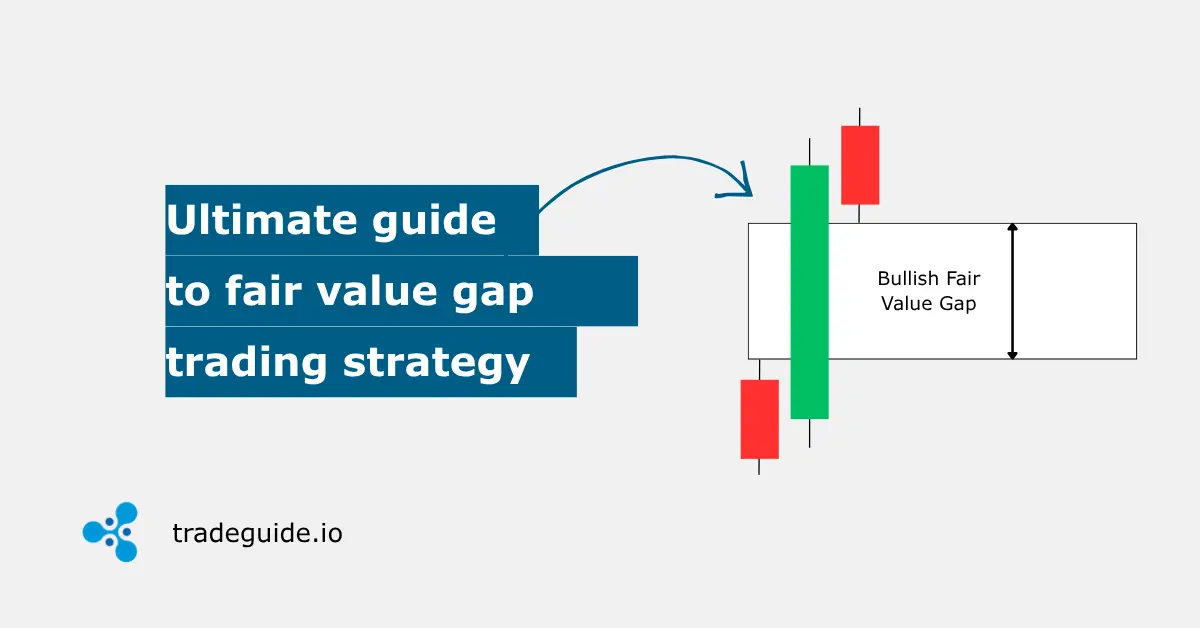
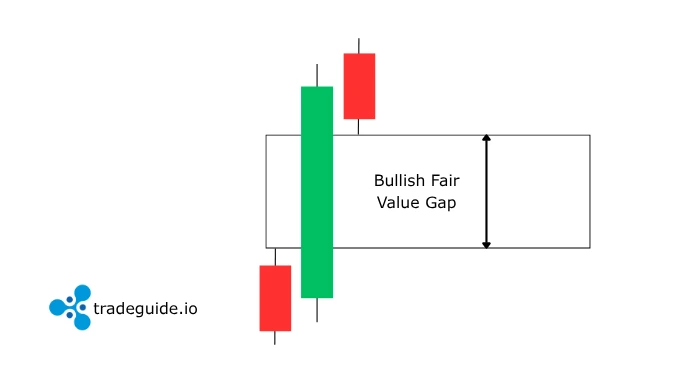
A fair value gap is a three-candle price imbalance where the market moves so fast that buyers and sellers never get a chance to trade at those prices.
Here’s the simple version:
- Candle 1 has a high (or low).
- Candle 2 is the “explosive” candle that creates the gap.
- Candle 3 has a low (or high) that doesn’t overlap with Candle 1.
The space between Candle 1’s high and Candle 3’s low (a bullish FVG) is the gap. Price left that zone fast. Smart money knows it. And in most cases, price will return to “fill” or re-test that area before continuing.
Think of it like this: Imagine a store that sold out of a product in seconds. Demand clearly exists at that price. Price is no different.
How the FVG Trading Strategy Works (Step-by-Step)
The FVG strategy isn’t just about spotting the gap; it’s about knowing when to act on it.
Here are the steps professional ICT traders follow:
Step 1: Identify the Displacement
Look for a strong, aggressive move away from a key level, an order block, a liquidity pool, or a market structure break. That move creates your FVG. Without displacement, the gap is weak.
Step 2: Mark the FVG Zone
Draw a box from:
- Top boundary: Candle 3’s low (bullish FVG)
- Bottom boundary: Candle 1’s high (bullish FVG)
This is the zone where you’ll look to enter. Don’t chase the price away from it.
Step 3: Wait for a Return to the Gap
Price needs to pull back into the zone. This is where most beginners get impatient and enter too early. Wait for the price to actually re-enter the FVG before considering a trade.
Step 4: Confirm Entry with Lower Timeframe (LTF) Signals
Drop to a 1-minute or 5-minute chart when price enters the FVG zone. Look for:
- A shift in market structure (a small break of structure opposite to your bias)
- An order block within the FVG
- A liquidity sweep before the reversal
Step 5: Set Your Stop and Target
- Stop loss: just below the full FVG (or the displacement candle’s origin)
- Target: the opposing liquidity level — an old high, a swing point, or the next FVG
Types of Fair Value Gaps You Need to Know
Not all FVGs are equal. Here are the commons you’ll encounter most:
Bullish FVG: Forms during upward displacement. Price returns from above and bounces. Used for long entries in a bullish market structure.
Bearish FVG: Forms during downward displacement. The price returns from below and is rejected. Used for short entries in a bearish market structure.
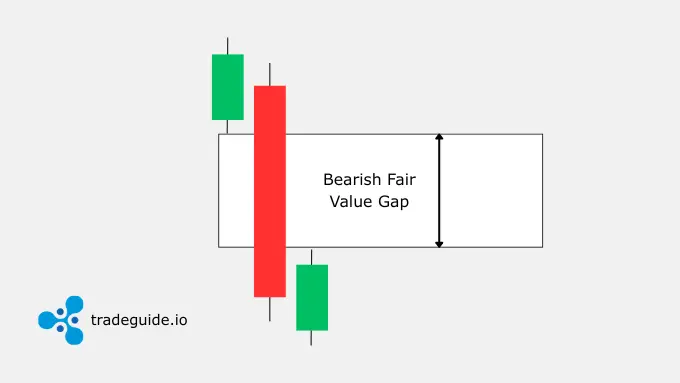
Knowing which type you’re dealing with changes your entry, your bias, and your stop placement completely.
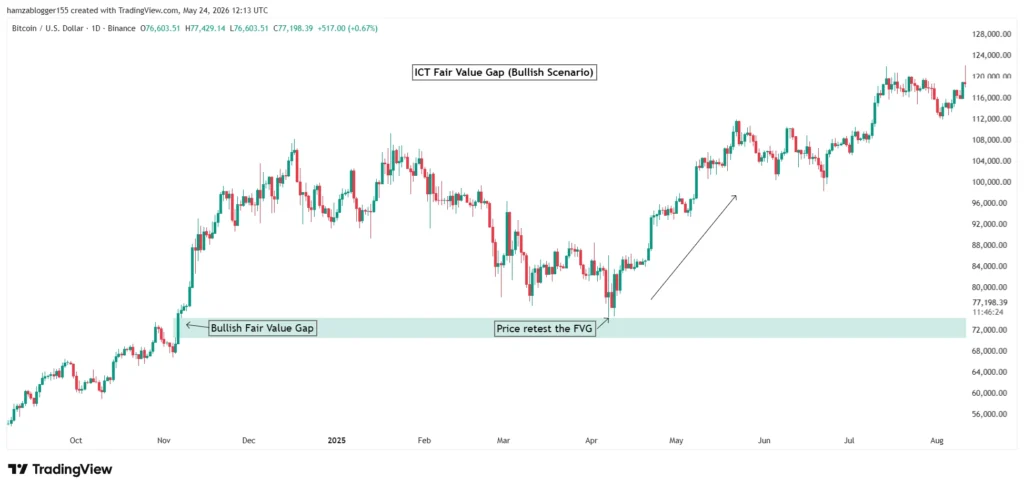
Live Examples:
Bullish Scenario:
Bearish Scenario:
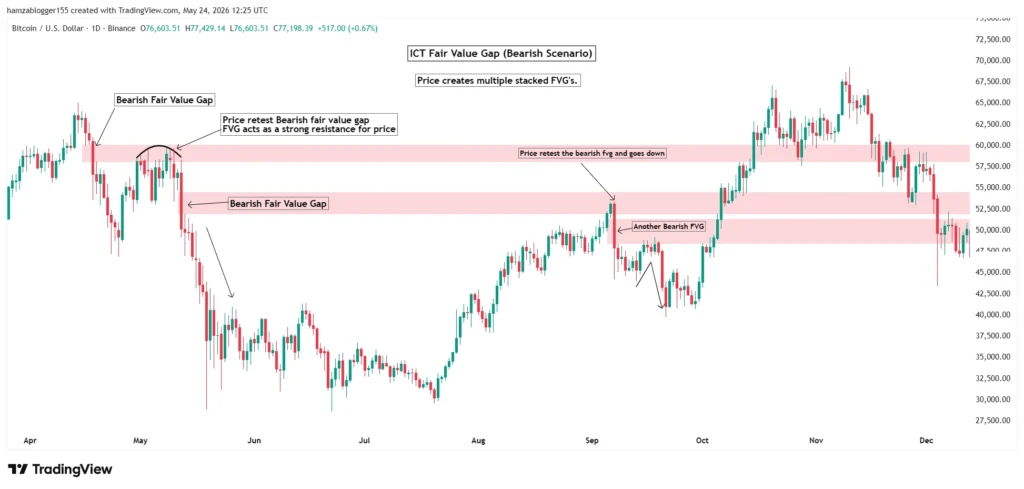
The Trader Edge: Common FVG Mistakes I See.
This is where most guides stop, but it’s where the real money is.
Mistake #1: Trading FVGs Without HTF Context
Spotting a gap on the 5-minute chart means nothing if the daily trend is pointing the other way. FVGs work best in the direction of the higher timeframe bias. Without that alignment, you’re essentially fighting institutional order flow.
Fix: Before marking any FVG, check your daily and 4H chart for the prevailing trend direction. Only take FVG setups that align with that bias.
Mistake #2: Entering at the First Touch
Price touching your FVG zone is not a signal. It’s a notification. Many traders rush to market order the moment the price hits the zone and get stopped out before the actual move begins.
Fix: Wait for confirmation. A structural shift or a wick rejection on the LTF inside the FVG is your signal, not the touch itself.
Mistake #3: Ignoring the Time of Day
ICT trading — including the fair value gap strategy — is heavily time-dependent. FVGs that fill during kill zones (London Open, New York Open) have a much higher probability than those that fill at random hours.
>> If you want to learn more about ICT Kill Zones. Read the blog post from inner circle trader on ICT Kill zones.<<
Mistake #4: Marking Every Gap You See
Here’s the truth: most FVGs don’t matter. The market creates imbalances constantly. You only want FVGs that form:
- After a liquidity sweep
- At a confluent level (order block, HTF FVG, or a key swing point)
- During active trading sessions
If you’re marking 10–15 FVGs per day, you’re not trading a strategy; you’re hunting setups that confirm whatever bias you already have.
Combining the FVG Trading Strategy with ICT Trading Concepts
The FVG trading strategy reaches its full potential when it’s part of a broader ICT framework not used in isolation.
Here’s how the pieces fit together:
- Market Structure: Use BOS (Break of Structure) or CHoCH (Change of Character) on the HTF to define your bias first.
- Liquidity Pools: The best FVG setups form after price runs to liquidity (equal highs/lows, stop hunts). The displacement that follows creates the most reliable gaps.
- Order Blocks: An FVG that overlaps with or sits just above an order block is a high-confluence zone. These setups have two reasons for the price to react to them:
- Time & Price: Only trade FVGs during the London or New York sessions. This is non-negotiable for serious ICT traders.
Conclusion
The FVG trading strategy is not a magic indicator or a shortcut. It’s a framework for reading how institutional money moves through the market.
Here’s what you’ve learned:
- What FVGs are: Three-candle imbalances that signal aggressive institutional moves
- How to trade them: Identify displacement → mark the zone → wait for return → confirm on LTF → execute with a defined R:R
- What to avoid: Trading without HTF bias, entering on first touch, ignoring session time, and over-marking gaps
Pair this with proper ICT structure and patience, and you have one of the most clean, repeatable edge strategies available to retail traders today.
Frequently Asked Questions
What is a Fair Value Gap in ICT trading?
A Fair Value Gap (FVG) in ICT trading is a three-candle price imbalance where price moves so aggressively that a gap forms between the high of Candle 1 and the low of Candle 3. It represents a zone of inefficiency that price often returns to rebalance before continuing its move.
How reliable is the FVG trading strategy?
The reliability of the FVG strategy depends on confluence. FVGs aligned with the higher timeframe trend, formed after a liquidity sweep, and traded during active sessions (London/New York) have a significantly higher probability than isolated gaps identified without context.
What is the difference between an FVG and an Inversion FVG?
A standard FVG acts as a support (bullish) or resistance (bearish) zone. An Inversion FVG (IFVG) occurs when price fully violates an existing FVG, flipping its polarity a previously bullish gap becomes resistance, and vice versa. These inversions are often high-conviction trade setups within the ICT model.
Ready to Go Deeper?
If this guide gave you clarity, you’ll love what we share in our weekly newsletter.
Every week we send:
- A real ICT trade breakdown (annotated chart included)
- One ICT concept explained in plain English
- Common mistakes we’re seeing traders make right now and how to avoid them
No spam. No fluff. Just practical ICT education for traders who are serious about improving.
[Subscribe to our free newsletter to get exciting information related to trading.]
You can unsubscribe anytime. But most subscribers tell us it’s the most useful forex email they get each week.
Risk Disclaimer: This article is for educational purposes only and does not constitute financial advice. Trading forex and other financial instruments involves significant risk. Always use proper risk management and consult a financial professional before making trading decisions.